Table Of Content
- Pre-Post With Non-Equivalent Control Group
- Employ a model or framework that covers both internal and external validity
- Pretest-Posttest Design
- QUASI-EXPERIMENTAL DESIGNS FOR PROSPECTIVE EVALUTION OF INTERVENTIONS
- STRATEGIES TO STRENGTHEN EXTERNAL VALIDITY
- Selecting and Improving Quasi-Experimental Designs in Effectiveness and Implementation Research
If there had been only one measurement of absences before the treatment at Week 7 and one afterward at Week 8, then it would have looked as though the treatment were responsible for the reduction. The multiple measurements both before and after the treatment suggest that the reduction between Weeks 7 and 8 is nothing more than normal week-to-week variation. Nonetheless, there are design strategies for non-experimental studies that can be undertaken to improve the internal validity while not eliminating considerations of external validity. It can be useful to obtain pre-test data or baseline characteristics to improve the comparability of the two groups. In the most controlled situations within this design, the investigators might include elements of randomization or matching for individuals in the intervention or comparison site, to attempt to balance the covariate distribution.
Pre-Post With Non-Equivalent Control Group
Finally, if participants in this kind of design are randomly assigned to conditions, it becomes a true experiment rather than a quasi experiment. In fact, it is the kind of experiment that Eysenck called for—and that has now been conducted many times—to demonstrate the effectiveness of psychotherapy. They found that overall psychotherapy was quite effective, with about 80% of treatment participants improving more than the average control participant. Subsequent research has focused more on the conditions under which different types of psychotherapy are more or less effective.
Employ a model or framework that covers both internal and external validity
Initially all clusters (or individuals) are unexposed to the intervention, and then at regular intervals, selected clusters cross over (or ‘step’) into a time period where they receive the intervention [Figure 3 here]. All clusters receive the intervention by the last time interval (although not all individuals within clusters necessarily receive the intervention). Data is collected on all clusters such that they each contribute data during both control and intervention time periods.
Pretest-Posttest Design
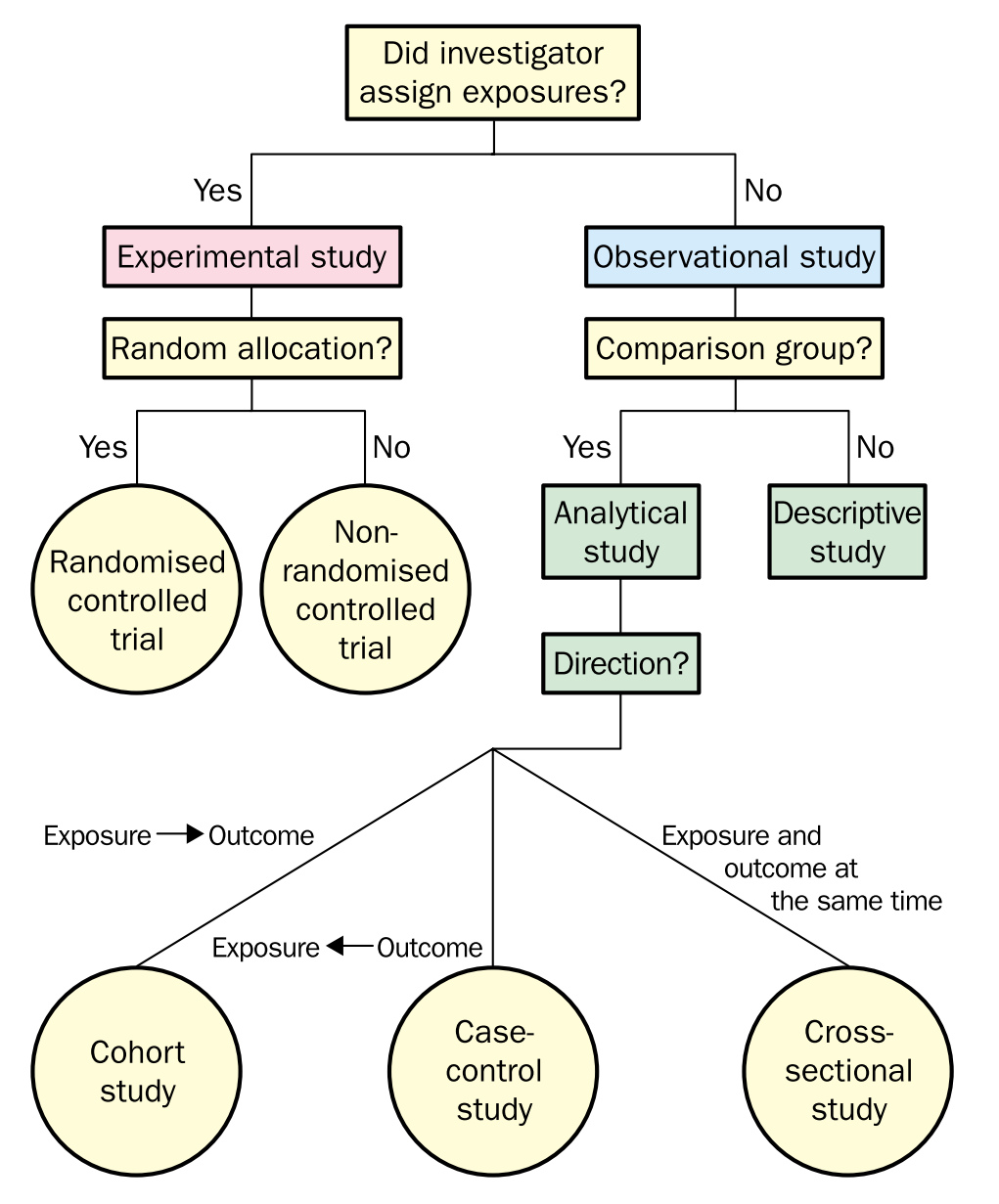
Individuals contributed follow-up time to the “pre-clinic” phase from the baseline date established for the cohort until the actual date of their first clinic visit, and also to the “post- clinic” phase thereafter. In a quasi-experimental design, the researcher uses an existing group of participants that is not randomly assigned to the experimental and control groups. Instead, the groups are selected based on pre-existing characteristics or conditions, such as age, gender, or the presence of a certain medical condition.
Public health practice involves implementation or adaptation of evidence-based interventions into new settings in order to improve health for individuals and populations. Such interventions typically include on one or more of the “7 Ps” (programs, practices, principles, procedures, products, pills, and policies) (9). Increasingly, both public health and clinical research have sought to generate practice-based evidence on a wide range of interventions, which in turn has led to a greater focus on intervention research designs that can be applied in real-world settings (2, 8, 9, 20, 25, 26, 10, 2). In a pretest-posttest design, the dependent variable is measured once before the treatment is implemented and once after it is implemented. Imagine, for example, a researcher who is interested in the effectiveness of an antidrug education program on elementary school students’ attitudes toward illegal drugs. The researcher could measure the attitudes of students at a particular elementary school during one week, implement the antidrug program during the next week, and finally, measure their attitudes again the following week.
Comparison of the teaching clinical biochemistry in face-to-face and the flex-flipped classroom to medical and dental ... - BMC Medical Education
Comparison of the teaching clinical biochemistry in face-to-face and the flex-flipped classroom to medical and dental ....
Posted: Tue, 13 Feb 2024 08:00:00 GMT [source]
Quasi-Experimental Research Design – Types, Methods
In a classic 1952 article, researcher Hans Eysenck pointed out the shortcomings of the simple pretest-posttest design for evaluating the effectiveness of psychotherapy. This method involves summarizing the data collected during a study using measures such as mean, median, mode, range, and standard deviation. Descriptive statistics can help researchers identify trends or patterns in the data, and can also be useful for identifying outliers or anomalies.
In particular, the addition of a control group can be particularly useful for assessing for the presence of seasonal trends and other potential time-varying confounders (52). Zombre et al (52) maintained a large number of control number of sites during the extended study period and were able to look at variations in seasonal trends as well as clinic-level characteristics, such as workforce density and sustainability. In addition to including a control group, several analysis phase strategies can be employed to strengthen causal inference including adjustment for time varying confounders and accounting for auto correlation. Imagine, for example, that students in one school are given a pretest on their attitudes toward drugs, then are exposed to an antidrug program, and finally are given a posttest. Students in a similar school are given the pretest, not exposed to an antidrug program, and finally are given a posttest. Again, if students in the treatment condition become more negative toward drugs, this could be an effect of the treatment, but it could also be a matter of history or maturation.
Characterize fidelity and measures of implementation processes
As well, when a complex intervention is related to a policy or guideline shift and implementation requires logistical adjustments (such as phased roll-outs to embed the intervention or to train staff), QEDs more truly mimic real world constraints. As a result, capturing processes of implementation are critical as they can describe important variation in uptake, informing interpretation of the findings for external validity. However, QEDs are often conducted by teams with strong interests in adapting the intervention or ‘learning by doing’, which can limit interpretation of findings if not planned into the design. As done in the study by Bailet et al (3), the investigators refined intervention, based on year 1 data, and then applied in years 2–3, at this later time collecting additional data on training and measurement fidelity.
Selecting and Improving Quasi-Experimental Designs in Effectiveness and Implementation Research
Perhaps an antidrug program aired on television and many of the students watched it, or perhaps a celebrity died of a drug overdose and many of the students heard about it. Participants might have changed between the pretest and the posttest in ways that they were going to anyway because they are growing and learning. If it were a yearlong program, participants might become less impulsive or better reasoners and this might be responsible for the change. Recall that when participants in a between-subjects experiment are randomly assigned to conditions, the resulting groups are likely to be quite similar.
The pretest-posttest design is much like a within-subjects experiment in which each participant is tested first under the control condition and then under the treatment condition. It is unlike a within-subjects experiment, however, in that the order of conditions is not counterbalanced because it typically is not possible for a participant to be tested in the treatment condition first and then in an “untreated” control condition. Imagine, for example, a researcher who wants to evaluate a new method of teaching fractions to third graders. One way would be to conduct a study with a treatment group consisting of one class of third-grade students and a control group consisting of another class of third-grade students.
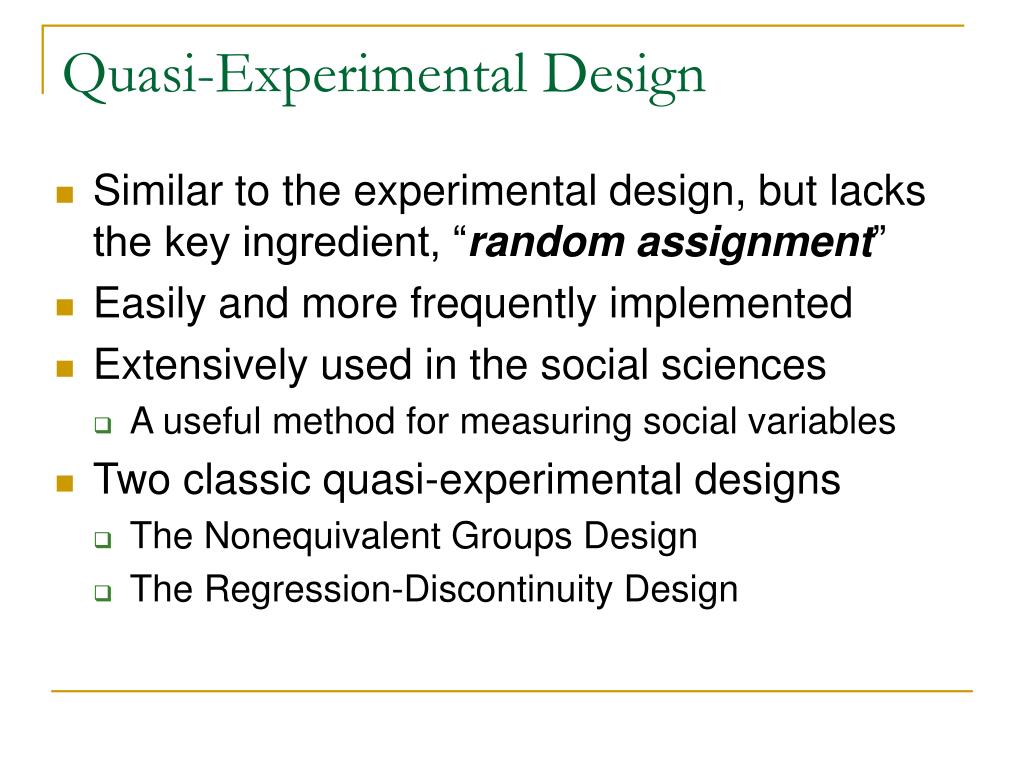
This design involves collecting data on the dependent variable(s) over a period of time, both before and after an intervention or event. The researcher can then determine whether there was a significant change in the dependent variable(s) following the intervention or event. This design involves selecting two groups of participants that are similar in every way except for the independent variable(s) that the researcher is testing. Quasi-experiments are most likely to be conducted in field settings in which random assignment is difficult or impossible. They are often conducted to evaluate the effectiveness of a treatment—perhaps a type of psychotherapy or an educational intervention. There are many different kinds of quasi-experiments, but we will discuss just a few of the most common ones here.




No comments:
Post a Comment